Ever hear that grumble from your stomach? That's your gut bacteria talking.
Our gut, which covers the area from the intestines to the colon are home to 100 trillion bacteria. These bacteria are very useful, and are essential for the human body to operate effectively. In fact, humans are composed of 90% bacteria! Each human has their own unique community of "good" bacteria in their gut, which evolve with the person's age, diet and biological changes. There are more than 10,000 species of bacteria, as complex as a rain-forest biome! For this reason, the gut weighs close to two to three kilograms - heavier than our brain.

Although the thought of bacteria residing inside your body may be disgusting, you must understand their importance. Gut bacteria (also known as Gut Flora) protect you from pathogens, provide vital nutrients, prepare our immune system, and influence your food choices and moods. The bacteria have a mind of their own, and instruct our brain to follow their lead (hence the term gut instinct). They produce neurotransmitters and send it through the Vagus nerve to the brain. The term "vagus" originates from the Latin root "vague" meaning general, or common to all. So, whatever your gut wants, it gets!
Gut flora needs a healthy diet so that it can colonize and regulate your body's good habits. An imbalance of good bacteria can lead to many conditions, such as deficiencies in your body's vitamins. Foods that can harm your gut flora (therefore harming you) are sugar in excessive amounts, processed or junk food, gluten, artificial sweeteners, corn syrup and soy. Instead, your diet should be supplemented with vegetables like asparagus, chicory, cocoa, the apple (especially its skin), flax seeds, unripe bananas, garlic, and onions. In addition, fermented foods greatly help in this process. These are very beneficial for your gut and for your health.

Researchers have found the foods (listed above) to help your gut. However, people who have taken too many antibiotics could have very few "good" bacteria colonies in their gut. So, after much research, they found a beverage which can entirely re-colonize your gut with "good bacteria." This drink is known as "Kefir," a fermented drink made from milk and yeast. I, myself, have tasted this drink before. It is a little sour, but almost tastes like buttermilk! This drink is not commercially produced** and not widely advertised, and people usually react with a "huh?" Still, it plays a major role to keep you healthy and content. The taste may be slightly queer, but it is sure worth the benefits. And my gut instinct tells me to have more!
**Mugdha Pradhan is the brain behind "Gut Instinct," a company promoting the consumption of Kefir. She gave a very informative talk at my school to encourage people to incorporate 200 or 500 mL of Kefir into their daily diet. Mugdha and her daughter make the Kefir together and sell it. They hope to see more happy guts, happy people, and a healthy world.
Our gut, which covers the area from the intestines to the colon are home to 100 trillion bacteria. These bacteria are very useful, and are essential for the human body to operate effectively. In fact, humans are composed of 90% bacteria! Each human has their own unique community of "good" bacteria in their gut, which evolve with the person's age, diet and biological changes. There are more than 10,000 species of bacteria, as complex as a rain-forest biome! For this reason, the gut weighs close to two to three kilograms - heavier than our brain.
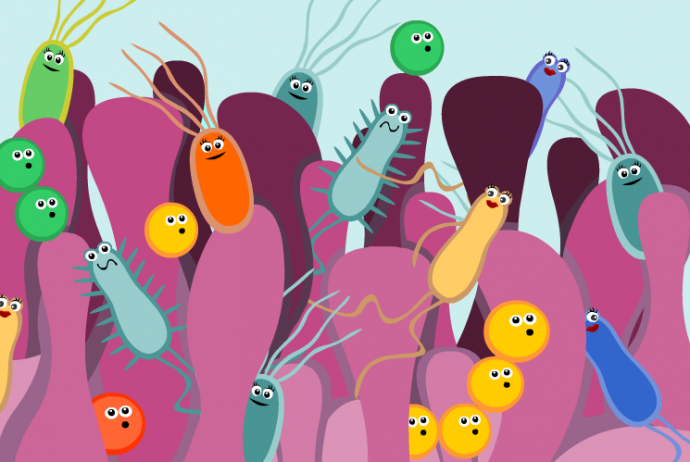
Although the thought of bacteria residing inside your body may be disgusting, you must understand their importance. Gut bacteria (also known as Gut Flora) protect you from pathogens, provide vital nutrients, prepare our immune system, and influence your food choices and moods. The bacteria have a mind of their own, and instruct our brain to follow their lead (hence the term gut instinct). They produce neurotransmitters and send it through the Vagus nerve to the brain. The term "vagus" originates from the Latin root "vague" meaning general, or common to all. So, whatever your gut wants, it gets!
Gut flora needs a healthy diet so that it can colonize and regulate your body's good habits. An imbalance of good bacteria can lead to many conditions, such as deficiencies in your body's vitamins. Foods that can harm your gut flora (therefore harming you) are sugar in excessive amounts, processed or junk food, gluten, artificial sweeteners, corn syrup and soy. Instead, your diet should be supplemented with vegetables like asparagus, chicory, cocoa, the apple (especially its skin), flax seeds, unripe bananas, garlic, and onions. In addition, fermented foods greatly help in this process. These are very beneficial for your gut and for your health.
Researchers have found the foods (listed above) to help your gut. However, people who have taken too many antibiotics could have very few "good" bacteria colonies in their gut. So, after much research, they found a beverage which can entirely re-colonize your gut with "good bacteria." This drink is known as "Kefir," a fermented drink made from milk and yeast. I, myself, have tasted this drink before. It is a little sour, but almost tastes like buttermilk! This drink is not commercially produced** and not widely advertised, and people usually react with a "huh?" Still, it plays a major role to keep you healthy and content. The taste may be slightly queer, but it is sure worth the benefits. And my gut instinct tells me to have more!
**Mugdha Pradhan is the brain behind "Gut Instinct," a company promoting the consumption of Kefir. She gave a very informative talk at my school to encourage people to incorporate 200 or 500 mL of Kefir into their daily diet. Mugdha and her daughter make the Kefir together and sell it. They hope to see more happy guts, happy people, and a healthy world.
Comments
Post a Comment